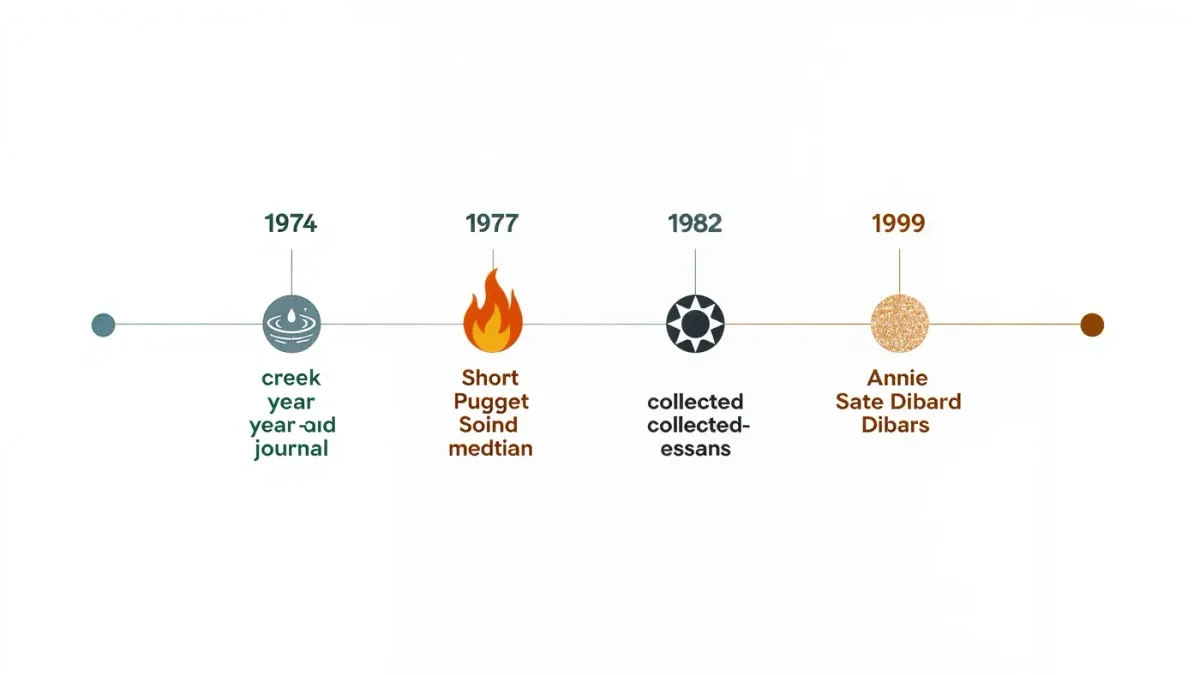
Start where everyone must: Pilgrim at Tinker Creek (1974), the account of a year of looking hard at one creek in Virginia's Roanoke Valley, which won the Pulitzer Prize for general nonfiction in 1975, when Dillard was twenty-nine. Read it slowly. Then Holy the Firm (1977), then the essays, then For the Time Being (1999), in that order.
What Kind of Writer Is Annie Dillard?
A naturalist with a prophet's register. The comparisons to Thoreau are standard and earned — Pilgrim at Tinker Creek knows exactly which shelf it sits on — but the temperature is her own: ecstatic attention, horror and beauty held in the same sentence without softening either. She stares at things until they confess, and then writes down the confession.
Early in Pilgrim at Tinker Creek she watches a giant water bug seize a frog and dissolve it from the inside, sucking it down until the animal simply decreases — an episode new readers never forget and rarely forgive. That is her method entire: the world observed with total seriousness, at length, until the observing itself becomes the religious act. Whether anything answers is precisely her subject.
What Happens in Each of the Four Books?
Pilgrim at Tinker Creek (1974) is one year of looking, in chapters arranged by season and by obsession — flood, seeing, fecundity, fear. Holy the Firm (1977) is a short book written on an island in Puget Sound, built around a seven-year-old girl from the parish burned in a small-plane accident, and it asks plainly whether a God of love can be innocent. Teaching a Stone to Talk (1982) collects the essays, including “Total Eclipse,” her account of the eclipse of February 26, 1979. For the Time Being (1999) is a mosaic of birth defects, sand, clouds, and the paleontologist Teilhard de Chardin.
The four books rhyme. All are about the silence of the world and the discipline of watching anyway; what changes is the ratio of facts to dread. Readers who want the creekside version start with the first; readers who want the argument at full pressure end at the last.
What Order Should You Read Dillard In?
- Pilgrim at Tinker Creek (1974), slowly — a chapter a night is the right speed.
- Holy the Firm (1977), in one sitting, by lamplight, weather permitting.
- Teaching a Stone to Talk (1982), starting with “Total Eclipse,” one of the most anthologized American essays of its century, and “Living Like Weasels.”
- For the Time Being (1999), last, when her habits are familiar enough to survive the book's form: short sections circling one set of unanswerable questions.
- Side trips whenever: The Writing Life (1989) on the craft, An American Childhood (1987) on where the attention came from.
Related stories: Where to Start With Augustine's Confessions · Where to Start With Kierkegaard.
Is Annie Dillard a Religious Writer?
Yes, the way a question can be religious. Churches, sacraments, and scripture recur — Catholic practice threads through Tinker Creek and carries Holy the Firm — but she joined nothing, and the God in these pages hides as often as he appears. The tradition she works nearest is apophatic: knowledge of God by way of what cannot be known. Dillard simply performs it with field glasses.
Readers looking for devotional comfort should know that she quotes Julian of Norwich and then reports, without flinching, a frog being eaten; the comfort and the horror are allowed to cancel, or not, as the reader manages. This unsettled piety is why skeptics and believers both claim her, usually accurately.
What Should You Notice While You Read?
Three habits organize everything she writes. First, the sentences themselves: Dillard builds long, clause-rich paragraphs that lean forward, and reading her at speed is like accepting a bet about your own attention span. Second, the pivots — a paragraph of entomology will turn, mid-page, into theology, and the seam is deliberately visible. Third, the abundance: the books are stuffed to bursting with fact, because for her fact is the devotional register, and exactness is how she honors what she is looking at.
Notice, too, what she refuses. There is no confession to join and no complaint about its absence; the books never resolve into testimony, and the last sentences rarely console. Readers trained to expect closure often feel cheated at the end of Holy the Firm or For the Time Being, put the book down, and then pick it up again the following month. That is the usual sequence, and the books seem built for it.
Frequently Asked Questions
Is Pilgrim at Tinker Creek religious?
Yes, in its fashion — nature mysticism argued with, rather than against, monotheism. God is treated as a live possibility who is also, repeatedly, absent, and the book's honesty about that is its reputation.
What is her most difficult book?
Holy the Firm is the densest per page, and For the Time Being the strangest in structure. Difficulty in Dillard is a matter of pressure, not obscurity.
Did she win a Pulitzer for anything else?
No. The 1975 prize for general nonfiction, for Pilgrim at Tinker Creek, is the one; she was twenty-nine, among the youngest recipients in that category.
What should I read next after these four?
Walden, to hear the debt out loud; Thomas Merton's essays, for the contemplative register; and then Dillard's own The Writing Life, to watch the attention examine itself.