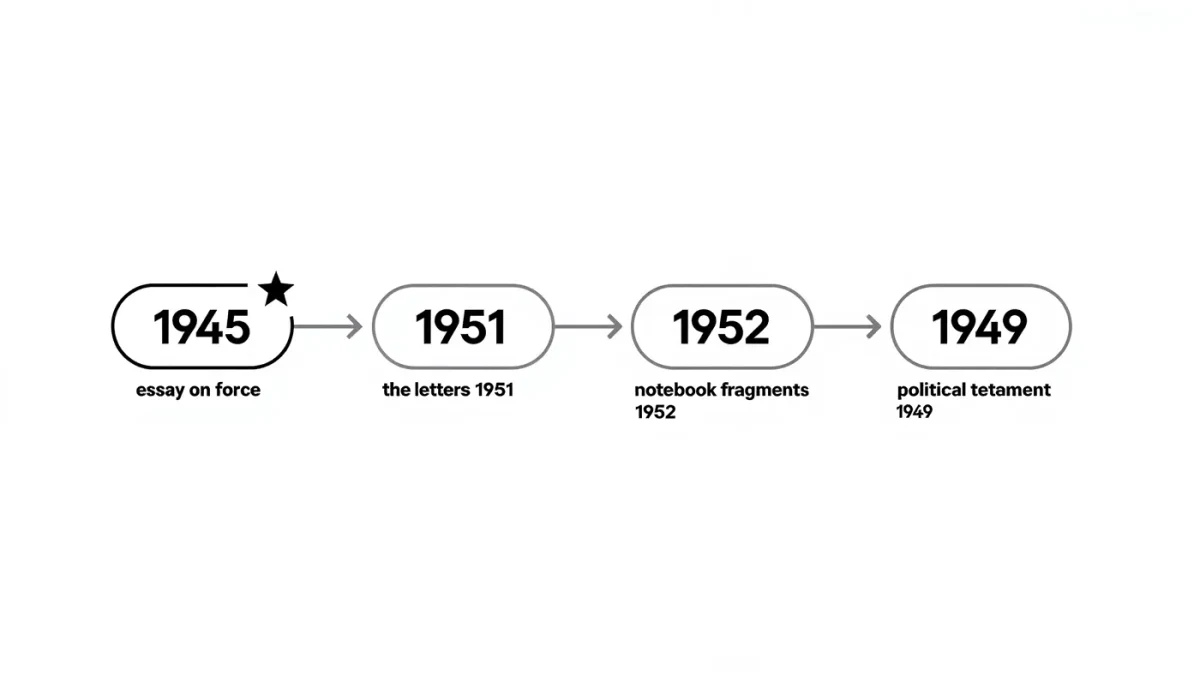
Begin with her essay The Iliad, or the Poem of Force, translated by Mary McCarthy in 1945 — twenty-odd pages that re-read Homer as a study of what force does to souls. Then Waiting for God, trans. Emma Craufurd, 1951. The famous Gravity and Grace (English 1952) is better third than first, because it is a book of fragments.
Who Was Simone Weil?
A French philosopher and mystic, 1909 to 1943: a teacher who spent a year on factory assembly lines to learn what that labor does to the body and soul; a would-be Republican soldier in 1936 whose war ended almost before it began; a mystic who prayed constantly and refused baptism. She died in a sanatorium in Kent in August 1943, thirty-four years old, of tuberculosis, weakened by refusing to eat more than she believed occupied France allowed.
The mystical turn is documented in her own letters, collected in Waiting for God. At Solesmes in 1937–38, suffering brutal headaches, she found herself reciting George Herbert's poem “Love” and reported that “Christ himself came down and took possession of me.” She then spent years standing outside the church — attending, arguing with priests she loved, declining to enter. Reading her without that double fact — mystic and refuser — flattens everything.
What Is Gravity and Grace?
Not a book she made: a posthumous compilation from her notebooks, assembled by the farmer-philosopher Gustave Thibon and published in French in 1947, in Emma Craufurd's English in 1952. Read it as what it is — a great notebook — and it behaves. Read as a treatise, it bewilders.
Its themes repeat across the fragments. Gravity pulls the soul down toward the mechanical and the self; grace is anything that lifts. “Decreation” is Weil's coinage for the creature's imitation of a God who, she argues, withdrew himself to make room for creation. Affliction — malheur — is her word for the crushing that goes beyond suffering and marks a person socially as well as bodily. None of this is offered gently. The book's tone is a held breath.
What Is Waiting for God About?
Letters and essays from the early 1940s, sent to Joseph-Marie Perrin, a Dominican friend. It contains her spiritual autobiography, her account of why she would not be baptized, and the strange essay on school studies in which she argues that attention — real, effortful attention to geometry or Latin — is the substance of prayer. Teachers keep the book in print for that essay alone.
It is also the place where her contradictions are most human: a longing for the sacraments joined to a vow to stay with the afflicted outside every institution, a love of Catholicism joined to verdicts on the Hebrew Scriptures that her own admirers have struggled to defend. The letters do not resolve the contradictions. They display them.
Related stories: Where to Start With the Desert Fathers · How to Read the Quran in Translation.
What Makes Weil Hard to Read?
Her severity: no consolation padding, no chat, and no interest in being liked; the sentences come down like weights, and the reader who wants a companionable sage should look elsewhere. Two honest warnings follow. First, her verdicts on Judaism and the Old Testament are harsh and have drawn justified criticism — read her with that argument open on the desk. Second, she writes as one convinced that affliction reveals truth, a premise not everyone will grant.
The remedy is pace. Weil read slowly — a page a day, a paragraph a day — reads like a completely different writer from Weil skimmed. And disagreement, kept precise, is a normal mode of reading her, not a failure of it. She would have distrusted assent that came cheaply.
What Order Should You Read Weil In?
- The Iliad, or the Poem of Force (written 1939–40; Mary McCarthy's translation, 1945) — force as it turns everyone it touches, victor included, into a thing.
- Waiting for God, trans. Emma Craufurd (1951).
- Gravity and Grace, trans. Emma Craufurd (1952) — a page or two a day, like a book of proverbs with teeth.
- The Need for Roots (French, 1949) — her postwar testament on obligation, work, and what a wounded country owes its people.
- After: Iris Murdoch's The Sovereignty of Good (1970), which argues with her profitably, and Simone Pétrement's biography for the life behind the fragments.
Frequently Asked Questions
Did Simone Weil ever join the Catholic Church?
No. She believed she was meant to stay on the threshold, sharing the lot of those outside every institution — the afflicted, workers, the unbaptized. Her refusal is described at length in Waiting for God.
Is Gravity and Grace her book?
Only posthumously. Gustave Thibon selected and arranged the fragments from notebooks she left with him; the French volume appeared in 1947, Craufurd's English in 1952. The arrangement is his, and it has shaped her reputation.
What should I read if I only read one thing?
The Iliad essay. It is complete in itself, needs no doctrine to be grasped, and shows the mind that the religious writings then apply to God.
Why did she refuse food at the end?
The account, broadly accepted though contested in its details, is that she would not eat more than the rations she believed available to people in occupied France while she was in England. Tuberculosis did the rest. Coronation of a saint is not the right genre for the story; neither is dismissal.